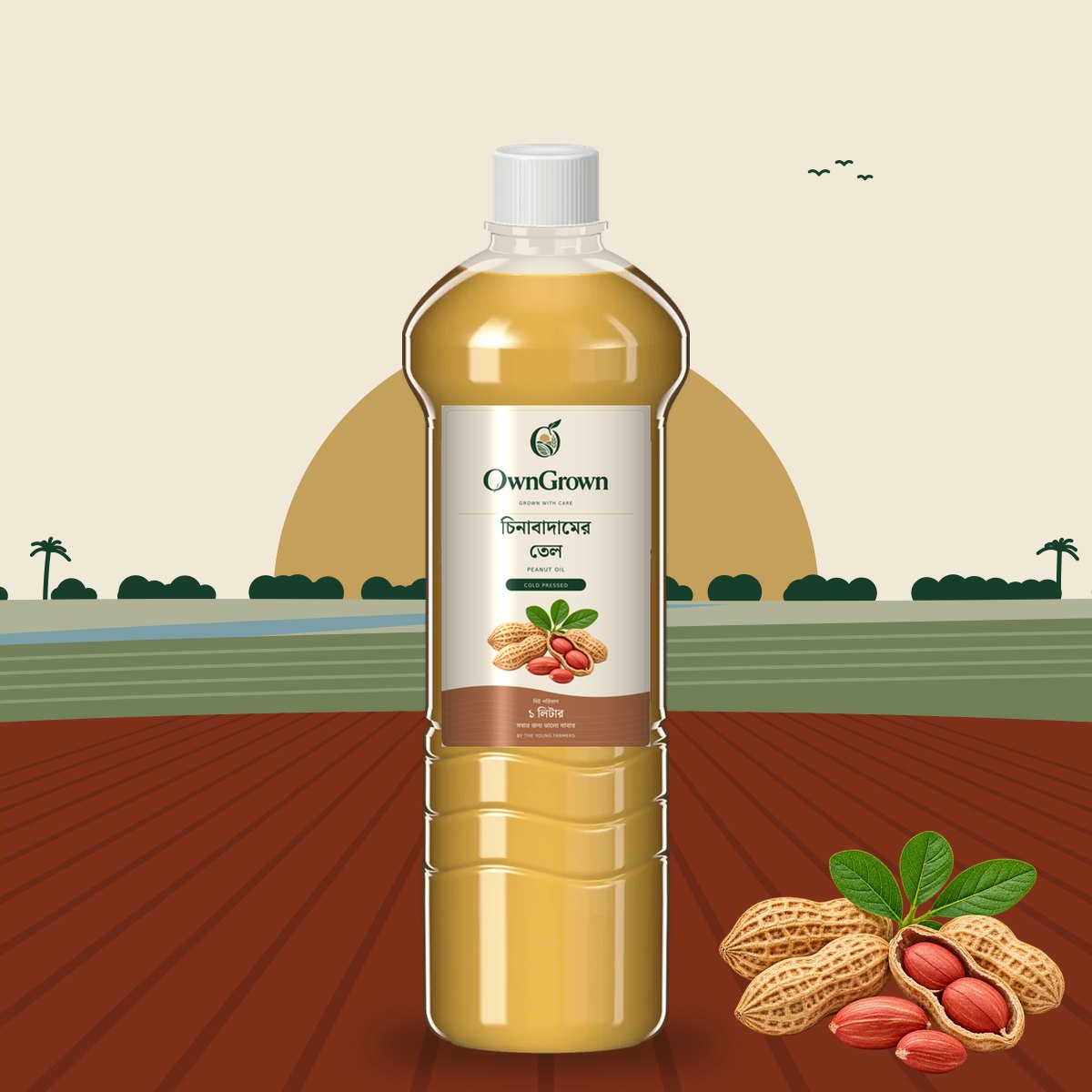
Peanut oil (many people call it badam tel) is oil pressed from peanuts. With a light nutty aroma, it is used for cooking and frying. Keep it tightly capped in a cool, dark place.
If you have a peanut allergy, do not use this oil at all. We explain why below.
Where our peanuts come from
We grow every OwnGrown crop ourselves. "Ourselves" means The Young Farmers: as an organisation, we work with farmers. We give technical farming advice and other support, and the peanut crop is grown using scientific methods under our supervision. After harvest, the farmers and we prepare it for sale together. We store the crop with great care, and we eat this oil ourselves too.
Peanuts grow underground, out of sight. It is grown in open fields, following the season, so the colour and aroma of the oil may vary slightly from batch to batch.
What cold-pressed means
No external heat is applied while pressing the oil from the nuts, and the oil is not refined. Our peanut oil has just one ingredient: peanuts. The oil is extracted on the first press in a cold-press machine. It is then not refined, only filtered through a centrifuge and a vacuum filter so that no impurities remain. Then it is bottled in Chukainagar, Arjuna, Bhuapur.
How to use it in cooking
- Bhaji and curries: With vegetables, fish or meat.
- Frying: For frying eggs, fish or aubergine.
- Fried rice or noodles: The light nutty aroma suits these dishes well.
Cook on medium heat, and do not reheat and reuse the same oil again and again.
Allergy: who should avoid it
Peanuts cause serious allergies for many people. In 1997, BMJ published a study in which 60 people with a peanut allergy were given two types of peanut oil [1]. No one reacted to the refined oil, but 6 of the 60 (10%) had an allergic reaction to the unrefined (crude) oil. The researchers said that people with the allergy should avoid unrefined peanut oil.
Our cold-pressed oil is not refined. So:
- If you have a peanut allergy, do not eat this oil.
- When cooking for guests or children, first check whether anyone has a peanut allergy.
How to store it
- Keep it in a cool, dark place with the lid tightly closed.
- Pour from the 5-litre bottle into a smaller bottle for daily use, and keep the large one closed.
- If the smell seems different, stop using it.
What research has found
This section is a simple summary of research published in international medical journals, not medical advice. The studies are on types of fat, not specifically on peanut oil or OwnGrown's oil. Do not use the oil to treat any illness or in place of medicine. If you are on medication, pregnant or breastfeeding, consult a doctor before changing your diet.
What is in peanut oil. According to the USDA, peanut oil is about 46% monounsaturated, 32% polyunsaturated and 17% saturated fat [2]. That means most of its fat is unsaturated.
Unsaturated fat and heart disease. In 2017 the American Heart Association (AHA) said that cutting saturated fat and replacing it with unsaturated fat, especially polyunsaturated fat, lowers LDL ("bad" cholesterol) and reduces heart disease [3]. In observational studies, people who eat less saturated fat and more poly- and monounsaturated fat have shown lower rates of heart disease and death [3].
Things to keep in mind. A 2020 Cochrane review says that how much benefit comes from replacing saturated fat with monounsaturated fat is still unclear, because there is little trial data [4].
In short: The benefit comes from using unsaturated oil in place of ghee, Dalda (vegetable shortening) or animal fat; not from eating extra oil. One tablespoon of oil contains about 120 calories [2], so cook with sensible amounts.
Questions and answers
Are chinabadam oil and badam tel the same? Usually, yes. In Bangladesh, "badam tel" means peanut oil (in English, peanut oil). Almond (kathbadam) oil is a different thing.
If I have an allergy, can I have a little? No. Our oil is not refined, so if you have a peanut allergy, do not eat this oil. If you have questions about any other oil, talk to a doctor.
Can the oil be reused after frying? It is best not to reheat and reuse the same oil again and again.
Final word
Our peanut oil comes in 1 litre and 5 litres. Delivery anywhere in the country ৳100, cash on delivery.
View OwnGrown peanut oil · All our cold-pressed oils · Read more: Sunflower oil: everyday cooking
Sources
- Hourihane JO, Bedwani SJ, Dean TP, Warner JO. Randomised, double blind, crossover challenge study of allergenicity of peanut oils in subjects allergic to peanuts. BMJ. 1997;314(7087):1084–1088. https://pubmed.ncbi.nlm.nih.gov/9133891/
- USDA FoodData Central. Oil, peanut, salad or cooking (FDC ID 171410). https://fdc.nal.usda.gov/food-details/171410/nutrients
- Sacks FM, Lichtenstein AH, Wu JHY, et al. Dietary fats and cardiovascular disease: a presidential advisory from the American Heart Association. Circulation. 2017;136(3):e1–e23. https://pubmed.ncbi.nlm.nih.gov/28620111/
- Hooper L, Martin N, Jimoh OF, Kirk C, Foster E, Abdelhamid AS. Reduction in saturated fat intake for cardiovascular disease. Cochrane Database Syst Rev. 2020;8:CD011737. https://pubmed.ncbi.nlm.nih.gov/32827219/