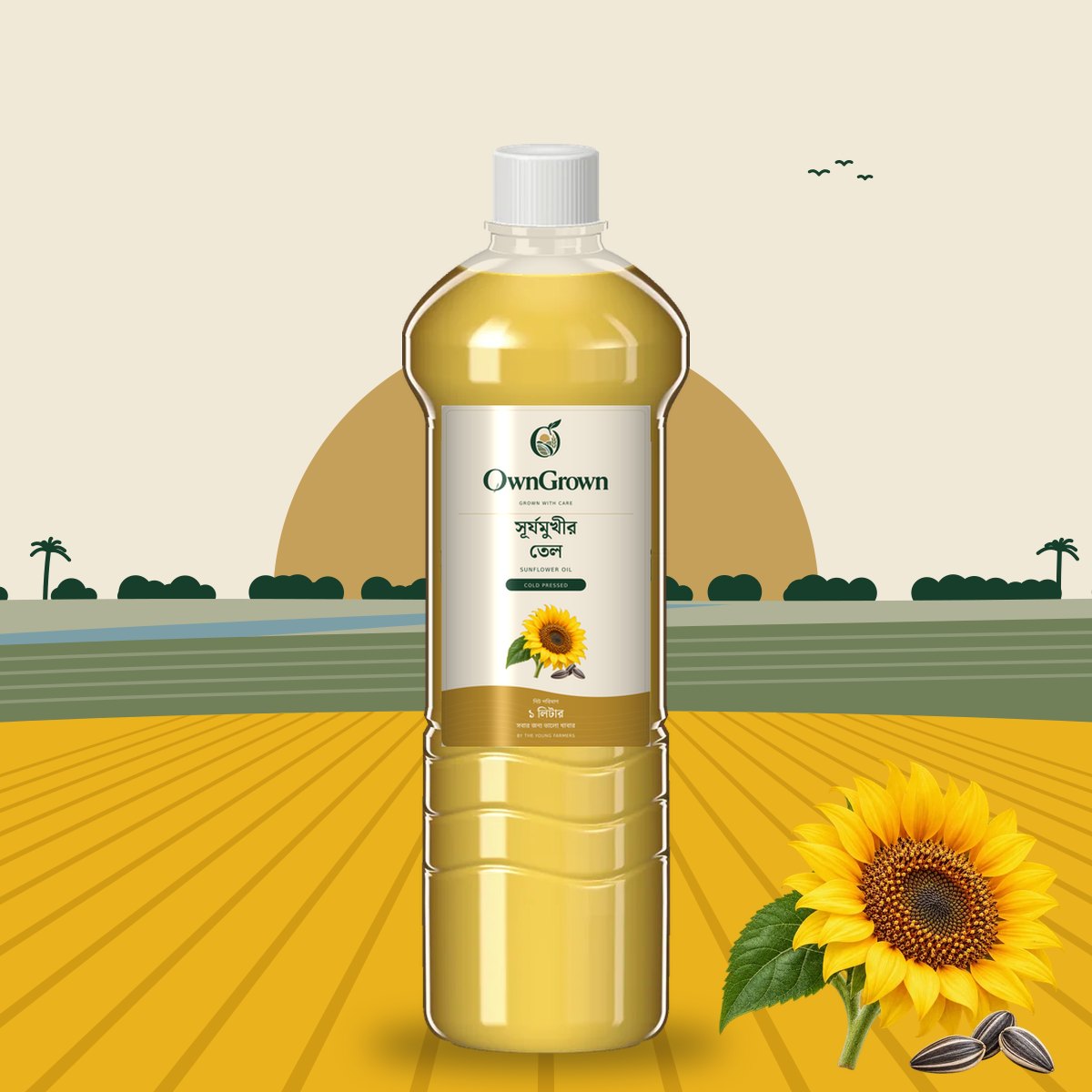
Sunflower oil is oil pressed from sunflower seeds. This mild-tasting oil can be used for everyday cooking, bhaji and curries. Keep it tightly capped in a cool, dark place, and do not reheat the same oil again and again.
Below we explain where our sunflower oil comes from, how to use it in cooking, and what research in medical journals has found about its fats.
Where our sunflower comes from
We grow every OwnGrown crop ourselves. "Ourselves" means The Young Farmers: as an organisation, we work with farmers. We give technical farming advice and other support, and the sunflower is grown using scientific methods under our supervision. After harvest, the farmers and we prepare it for sale together. We store the crop with great care, and we eat this oil ourselves too.
The flowers in the field have only just started to bloom; next comes the wait for the seeds to ripen. It is grown in open fields, following the season, so the colour and aroma of the oil may vary slightly from batch to batch.
What cold-pressed means
No external heat is applied while pressing the oil from the seeds, and the oil is not refined. Our sunflower oil has just one ingredient: sunflower seeds. The oil is extracted on the first press in a cold-press machine. It is then not refined, only filtered through a centrifuge and a vacuum filter so that no impurities remain. Then it is bottled in Chukainagar, Arjuna, Bhuapur.
How to use it in cooking
- Bhaji: In potato, pointed gourd, leafy greens or any vegetable bhaji.
- Curries: In fish, meat or vegetable curries.
- Tempering for dal: For a tempering of onion, garlic and dried chillies.
- Eggs: For fried eggs or egg curry.
Cook on medium heat. If the oil starts to smoke, turn the heat down.
What not to do
- Do not reheat and reuse the same oil again and again.
- This oil is not for repeated deep-frying; it is best for cooking with a little oil.
- Do not keep the bottle near the stove or in the sun.
How to store it
- Keep it in a cool, dark place with the lid tightly closed.
- Pour from the 5-litre bottle into a smaller bottle for daily use, and keep the large one closed.
- If the smell seems different, stop using it.
What research has found
This section is a simple summary of research published in international medical journals, not medical advice. The studies are on the types of fat found in sunflower oil; no separate study has been done on OwnGrown's oil. Do not use the oil to treat any illness or in place of medicine. If you are on medication, pregnant or breastfeeding, consult a doctor before changing your diet.
What is in sunflower oil. According to the USDA, about two-thirds (around 66%) of regular sunflower oil is linoleic acid, a type of polyunsaturated (omega-6) fat; saturated fat is about 10% [1]. One tablespoon contains about 5.6 mg of vitamin E [1]. These figures vary somewhat by sunflower variety.
Linoleic acid and heart disease (observational studies). In 2014, Circulation published an analysis that looked at data from more than 310,000 people in 13 studies [2]. Compared with those who ate the least linoleic acid, those who ate the most had a 15% lower risk of coronary heart disease and a 21% lower risk of dying from it. When 5% of daily calories came from linoleic acid instead of saturated fat, the risk was 9% lower. These findings show associations; they do not prove cause.
What controlled trials have found. A 2020 Cochrane review includes data from about 57,000 people in 15 trials [3]. Cutting saturated fat in the diet for at least two years reduced combined events such as heart disease and stroke by 17%. The review described replacing saturated fat with polyunsaturated fat as an effective approach. However, no significant difference was found in overall risk of death.
In 2017 the American Heart Association (AHA) also said that in trials where saturated fat was replaced with vegetable polyunsaturated oils, heart disease fell by about 30% [4].
In short: The benefit comes from using an unsaturated oil like sunflower in place of ghee, Dalda (vegetable shortening) or animal fat; not from eating extra oil. One tablespoon of oil contains about 120 calories [1], so cook with sensible amounts.
Questions and answers
Are surjomukhi oil, surjomukhi tel and sunflower oil the same? Yes. On our page it is called সূর্যমুখীর তেল · Sunflower Oil.
What is the difference between cold-pressed and refined sunflower oil? Cold-pressed oil is pressed from the seeds and bottled, so some of the seed's own colour and aroma remains. Refined oil is purified in several stages, so its colour and aroma are lighter.
Can you deep-fry with sunflower oil? It is best for bhaji and curries made with a little oil. Avoid repeated deep-frying and reheating the same oil.
Final word
Our sunflower oil comes in 1 litre and 5 litres. Delivery anywhere in the country ৳100, cash on delivery.
View OwnGrown sunflower oil · All our cold-pressed oils · Read more: Peanut oil: cooking and precautions
Sources
- USDA FoodData Central. Oil, sunflower, linoleic (approx. 65%) (FDC ID 171025). https://fdc.nal.usda.gov/food-details/171025/nutrients
- Farvid MS, Ding M, Pan A, Sun Q, Chiuve SE, Steffen LM, Willett WC, Hu FB. Dietary linoleic acid and risk of coronary heart disease: a systematic review and meta-analysis of prospective cohort studies. Circulation. 2014;130(18):1568–1578. https://pubmed.ncbi.nlm.nih.gov/25161045/
- Hooper L, Martin N, Jimoh OF, Kirk C, Foster E, Abdelhamid AS. Reduction in saturated fat intake for cardiovascular disease. Cochrane Database Syst Rev. 2020;8:CD011737. https://pubmed.ncbi.nlm.nih.gov/32827219/
- Sacks FM, Lichtenstein AH, Wu JHY, et al. Dietary fats and cardiovascular disease: a presidential advisory from the American Heart Association. Circulation. 2017;136(3):e1–e23. https://pubmed.ncbi.nlm.nih.gov/28620111/