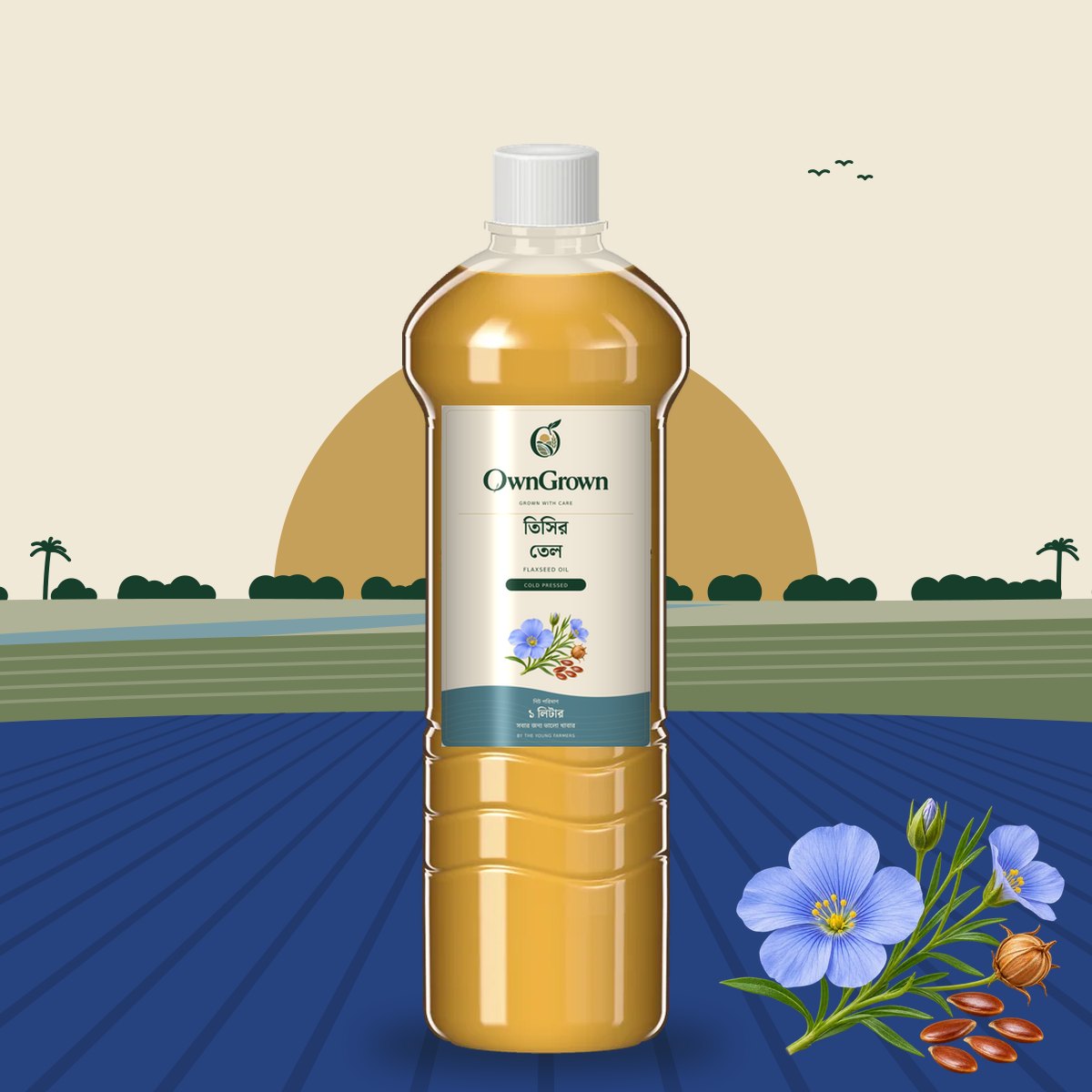
Flaxseed oil is the oil pressed from flaxseed (tishi). In many areas, tishi is also called mosina. The oil is usually eaten raw rather than heated: a little in salads, in bhorta, or over food after cooking. After opening, keep it in a cool, dark place with the lid closed, and finish it soon.
Below, we explain where our flaxseed oil comes from, how to eat and store it, and what research in medical journals has found about flaxseed oil.
Where the flaxseed comes from
We grow every OwnGrown crop ourselves. "Ourselves" means The Young Farmers: as an organisation, we work with farmers. We give technical farming advice and other support, and the flaxseed is grown using scientific methods under our supervision. After harvest, the farmers and we prepare it for sale together. We store the crop with great care, and we eat this oil ourselves too.
Flaxseed is a winter crop. It is grown in open fields with the seasons, so the oil's colour and aroma may vary slightly from one batch to the next. This is normal.
What cold-pressed means
Cold-pressed means no heat is applied from outside while the oil is extracted from the seeds, and the oil is not refined. Our flaxseed oil has just one ingredient: flaxseed. The oil is extracted in the first press of a cold-press machine. It is not refined, only filtered through a centrifuge and a vacuum filter so that no impurities remain. It is then bottled in Chukainagar, Arjuna, Bhuapur.
How to eat it: 5 easy ways in everyday food
- In bhorta: Add a little flaxseed oil at the end when mixing potato, aubergine or dal bhorta.
- In salads: In a cucumber, tomato and onion salad, with lemon juice and salt.
- Over food after cooking: A few drops on the plate over dal, vegetables or khichuri once it is off the heat.
- In chutney or yoghurt: In coriander or mint chutney, or mixed into plain yoghurt.
- In muri makha (spiced puffed rice): A little, if you like the taste.
If it is new to you, start with a little. If you like the taste, add more as you wish.
What not to do
- Do not use it for frying or high-heat cooking. Heat spoils its taste and aroma.
- Do not keep the bottle near the stove or in the sun.
- Do not leave the lid open after use.
How to store it
- Keep it in a cool, dark place with the lid tightly closed.
- Finish it soon after opening. Many people keep it in the fridge once opened.
- If it smells sharp or off, do not eat it.
- For small families, 250 or 500 ml bottles are handy, as they are used up soon after opening.
What research has found
This section is a simple summary of research published in international medical journals, not medical advice. The studies are about flaxseed oil and its omega-3; there has been no separate study on OwnGrown's oil. Do not take the oil to treat any disease or in place of medicine. If you are on medication, pregnant or breastfeeding, talk to your doctor before changing your diet.
What flaxseed oil contains. Flaxseed oil is a very rich source of alpha-linolenic acid (ALA), a plant-based omega-3 fat. According to USDA figures, about 53% of cold-pressed flaxseed oil is ALA; that means one teaspoon (about 4.5 g) contains about 2.4 g of ALA [1]. The adequate daily intake of ALA for adults is set at 1.6 g for men and 1.1 g for women [2].
ALA and heart disease (observational studies). A large analysis published in the BMJ in 2021 looked at data from about 1.2 million people across 41 studies [3]. Compared with people who ate the least ALA, those with the most ALA in their diet had a 10% lower risk of death from any cause, an 8% lower risk of death from heart and blood vessel disease, and an 11% lower risk of death from coronary heart disease. The same analysis found a slightly higher (6%) risk of death from cancer. These are observational studies: they show an association, not proof of cause. And the ALA came from many different foods, not only flaxseed oil.
Flaxseed oil and blood fats (controlled trials). A 2026 meta-analysis pooled data from 1,959 adults in 36 trials [4]. In the groups taking flaxseed oil, triglycerides fell by about 8 mg/dL on average. However, no significant change was found in total cholesterol, LDL ("bad" cholesterol) or HDL.
Blood pressure. A 2024 analysis looked at 17 trials of olive oil and flaxseed oil, only 3 of which were on flaxseed oil. No significant effect was found on blood pressure or markers of inflammation [5].
Safety. The NCCIH, part of the US National Institutes of Health (NIH), says flaxseed oil supplements in limited amounts may be safe for short periods (up to 6 months). Higher doses may cause bloating, a feeling of fullness or diarrhoea [6].
In short: Flaxseed oil is a very good source of omega-3 (ALA). Large studies have found an association between more ALA in the diet and a somewhat lower risk of death from heart disease. But evidence that flaxseed oil itself lowers cholesterol or blood pressure is still weak. And one tablespoon of oil has about 120 calories [1], so be mindful of how much you use.
Questions and answers
Flaxseed oil, mosina oil and "tisi tel": are they all the same? Yes. In some areas tishi is also called mosina, and many people search in English letters as tisi tel or tishir tel. In English it is called flaxseed oil.
Can you cook or fry with flaxseed oil? Generally, no. It is usually eaten raw. Add it over food after cooking.
How much can you have in a day? A little in cooking or over food is enough. One teaspoon alone contains more than an adult's adequate daily intake of ALA [1][2]. We do not suggest any dose as a medicine.
How long does it keep after opening? Check the expiry date on the bottle label. After opening, keep it in a cool, dark place and finish it soon. If the smell changes, do not eat it.
Does flaxseed oil work as a medicine? No. The studies are about ALA and flaxseed oil, and the results are mixed. For treating any illness, follow the medicine and advice your doctor gives you.
Final word
If flaxseed oil is new to you, start with a little in bhorta or salads. Our flaxseed oil comes in 250 ml, 500 ml and 1 litre. Delivery ৳100 anywhere in Bangladesh, cash on delivery.
See OwnGrown flaxseed oil · All our cold-pressed oils · Read more: Black seed oil: what the research says
Sources
- USDA FoodData Central. Oil, flaxseed, cold pressed (FDC ID 167702). https://fdc.nal.usda.gov/food-details/167702/nutrients
- NIH Office of Dietary Supplements. Omega-3 Fatty Acids: Fact Sheet for Consumers. https://ods.od.nih.gov/factsheets/Omega3FattyAcids-Consumer/
- Naghshi S, Aune D, Beyene J, Mobarak S, Asadi M, Sadeghi O. Dietary intake and biomarkers of alpha linolenic acid and risk of all cause, cardiovascular, and cancer mortality: systematic review and dose-response meta-analysis of cohort studies. BMJ. 2021;375:n2213. https://pubmed.ncbi.nlm.nih.gov/34645650/
- Ahmadi-Khorram M, Takhttavous A, Mohammadi-Sartang M, et al. Effect of flaxseed oil supplementation on lipid profile in adults: a systematic review and dose-response meta-analysis of randomized controlled trials. Avicenna J Phytomed. 2026;16(4):597–617. https://pubmed.ncbi.nlm.nih.gov/42920971/
- McNabb TB, Young I, Newman RG, Skinner RC, Benedito VA, Tou JC. Supplementation of olive oil and flaxseed oil on blood pressure and inflammation in healthy and at-risk adults: a systematic literature review and meta-analysis. Curr Hypertens Rev. 2024;20(3):141–155. https://pubmed.ncbi.nlm.nih.gov/39558500/
- National Center for Complementary and Integrative Health (NIH). Flaxseed and Flaxseed Oil. https://www.nccih.nih.gov/health/flaxseed-and-flaxseed-oil